Newsletter Fall 2026

Featured in this month’s newsletter:
- Aging GPS: Why Now Is the Time to Explore Senior Living – Joan Harris, LSW, MBA, CMC, Founder of Symphony Care Management
- Medicare Open Enrollment: Why It Is Important to Review Your Coverage – Jean Clements, CDES, Practice Manager, Certified Dementia Engagement Specialist
- What is Dementia Caregiving? – Julia Nickrosz, CDP, Aging Life Care Manager, Dementia Specialist
- Dementia Engagement Specialist – The Joy of the Work – Jean Clements, CDES, Practice Manager, Certified Dementia Engagement Specialist
- Join Our Team and Walk to Cure Alzheimer’s Disease – Joan Harris, LSW, MBA, CMC, Founder of Symphony Care Management

Aging GPS: Why you need to learn about your senior living options earlier than in the past.
Joan Harris, LSW, MBA, CMC
Throughout this year, I have been seeing more independent older adults come to our Aging GPS planning program who have planned ahead—but are now stuck. They chose a Continuing Care Retirement Community (CCRC) several years ago, joined its waiting list, and expected that by now an apartment would be available. Instead, they are being told, “It could still be a number of years,” or “It’s hard to know when an apartment will come up.”
Their trust and estate attorneys and financial advisors have recommended that they come to me to explore alternatives. These clients did what they thought they needed to do to prepare for their future. Yet they remain in limbo.
A second group of older adults comes to Aging GPS ready to move but having not yet explored their options. Some are already managing cognitive changes or medical conditions, although they continue to function well at home without services. For these clients, timing matters. Waiting another two to five years may no longer fit their circumstances, and as their needs change, the options available to them may change as well.
These experiences prompted me to research what is happening in the senior living marketplace. Are these long waiting lists unique to Greater Boston? Is relief on the horizon?
The findings were striking. According to the National Investment Center for Seniors Housing & Care (NIC), Boston’s senior housing occupancy reached 94.0% in the third quarter of 2026, the highest among the 31 primary markets it tracks. These figures reflect the broader senior housing market, rather than CCRC waiting lists specifically, but they provide important context for what I am seeing in my practice.
Meanwhile, new construction has slowed substantially. In the second quarter of 2026, fewer than 24,000 senior housing units were under construction across the 99 metropolitan markets tracked by NIC MAP—the lowest level since 2012. NIC MAP suggests that substantial inventory growth from a new construction cycle is unlikely to reach the market before 2030. This does not mean that no new communities will open before then, but it does suggest that a significant increase in availability will take time.
Massachusetts is also aging. More than 1.8 million residents are age 60 or older, representing approximately one-quarter of the state’s population.
Taken together, these trends suggest that long waiting lists are unlikely to ease quickly. Being ready to move does not necessarily mean that the community you want will be ready for you. Even joining a waiting list years in advance may leave you needing an alternative plan.
This is why planning before you need a change—and before you want to move—is so important.
Aging GPS: Goals, Priorities, Strategies, helps you understand your choices and develop a plan based on your unique priorities and vision for aging. We take time to understand who you are, what matters to you, and your financial and health considerations. We then help you compare communities, their services, payment structures, and the quality factors we look for when evaluating a good fit.
For some clients, that means exploring rental communities rather than communities requiring a substantial entrance fee. For others, it means considering a different location or learning about options they did not know existed. If you are already waiting for your preferred community, we can help you explore alternatives while keeping that preference in view.
Planning also includes support while you wait. Our team of Care Managers can help coordinate care and advocate for you if an unexpected health event occurs. Our quarterly check-in visits for Aging GPS clients provide an opportunity to review how you are doing and whether your plan needs to change.
You do not have to be ready to move to begin planning. Contact us to learn about Aging GPS and our quarterly check-in visits. 800.331.6991

New to Medicare? Or Already Enrolled? Start Here.
Jean Clements, CDES, Practice Manager, Certified Dementia Engagement Specialist
Medicare Open Enrollment • October 15 – December 7, 2026
Even if you are happy with your current coverage, review it each year. Plans can change — and your healthcare, prescription and provider needs can change, too.
WHY YOUR CHOICE CAN MATTER LATER
In our work as Care Managers, we often begin working with clients and their families’ decades after they first selected their health coverage. By that time, their healthcare needs may be very different.
We frequently see situations where coverage that once worked well may no longer provide the flexibility a client needs as health and care needs become more complex. For example, some Medicare Advantage and managed-care plans use specific provider networks, which can affect the hospitals, skilled nursing and rehabilitation facilities, specialists and other providers available under the plan. These plans may also require prior authorization for certain services or care.
When a serious illness, hospitalization, rehabilitation stay or home health need arises, understanding these coverage rules can become especially important. That’s why Medicare coverage should not be viewed as a one-time decision: understand your choices when you first enroll, and continue reviewing them as your needs change.
YOUR YEARLY REVIEW
- Are my doctors and specialists still in the plan/network?
- Are my medications still covered, and have coverage requirements changed?
- Is my preferred pharmacy still participating?
- Have benefits, prior authorization requirements or out-of-pocket costs changed?
- Does my coverage give me access to the hospitals, rehabilitation facilities, home health services and other providers I may need?
- Have my own healthcare needs changed?
- Would another Medicare option better meet my needs for 2027?
REVIEW DOESN’T MEAN YOU HAVE TO SWITCH
The goal is to review your coverage every year — not necessarily change it. If your current coverage still meets your needs, keeping it may be the right choice. Review. Compare. Then decide.
NEED HELP? MASSACHUSETTS HAS A FREE RESOURCE
SHINE — Serving the Health Insurance Needs of Everyone
Massachusetts offers free, unbiased Medicare information, counseling and assistance through SHINE. Certified, trained SHINE counselors can help people with Medicare and their caregivers understand coverage options and look for ways to save on health insurance and prescription drug costs.
A SHINE counselor can help you understand Original Medicare and Medicare Advantage, compare Part D and Medigap options, review prescription coverage, and work through Medicare enrollment decisions. Counseling is available through community resources across Massachusetts.
Massachusetts SHINE Program: mass.gov/shine-program
PLAN AHEAD
Appointments can fill quickly as Medicare Open Enrollment approaches. We encourage clients and families to seek guidance early. We can also assist with scheduling a SHINE appointment or arranging transportation to an appointment. Please contact us as early as possible so there is adequate time to review your options.
For current Medicare members:
• October 1, 2026 — begin reviewing 2027 options
• October 15–December 7, 2026 — Open Enrollment
• January 1, 2027 — changes take effect.
Medicare enrollment rules and plan details vary by individual circumstances.
Sources: Medicare.gov and Massachusetts SHINE.
A simpler guide to understanding your choices and reviewing them as your needs change.
NEW TO MEDICARE? START WITH A & B
| PART A = HOSPITAL
Helps cover inpatient hospital care and certain other services. |
PART B = MEDICAL
Helps cover doctors, outpatient care, preventive services and other medical care. |
Together, Part A + Part B = Original Medicare.
THEN CHOOSE HOW YOU WANT TO RECEIVE YOUR COVERAGE
| PATH 1 — ORIGINAL MEDICARE
Keep Parts A & B. You may also add: PART D — prescription drug coverage MEDIGAP — supplemental insurance that helps with certain out-of-pocket costs in Original Medicare |
PATH 2 — MEDICARE ADVANTAGE (PART C)
A Medicare-approved private plan provides your Part A & B benefits. Most plans include Part D and may offer additional benefits. Provider networks and prior authorization may apply. |
PART D vs. MEDIGAP — WHAT’S THE DIFFERENCE?
| PART D = PRESCRIPTION DRUGS
Think: “D = Drugs.” • Helps pay for prescription medications. • With Original Medicare, Part D is generally a separate private drug plan. • Each plan has its own formulary (list of covered drugs), pharmacies and coverage rules. • It does not supplement your hospital and doctor bills. |
MEDIGAP = MEDICARE SUPPLEMENT
Think: helps fill some of Original Medicare’s “gaps.” • Works with Original Medicare — it does not replace it. • Helps pay certain copayments, coinsurance and deductibles left by Original Medicare, depending on the policy. • Does not include prescription drug coverage in policies sold after 2005. • You cannot use Medigap with Medicare Advantage. |
|
| THE SIMPLEST WAY TO REMEMBER IT
Original Medicare: A + B | Add Part D for prescriptions | Add Medigap to help with certain Original Medicare out-of-pocket costs OR Medicare Advantage (Part C): another way to receive A + B; most plans include Part D. |
||
FIRST-TIME ENROLLMENT IS DIFFERENT
Your Initial Enrollment Period is tied to when you first become eligible for Medicare. Don’t assume you need to wait for the October–December annual Open Enrollment Period to sign up. If you choose Original Medicare, the timing of Medigap can also matter, so consider getting unbiased guidance early.
For additional information in selecting the best plan, Medicare.gov basics

Caregiver Coaching: Knowing What to Do is Only Part of the Equation
Julia Nickrosz, CPC, CDP, Aging Life Care Manager, Dementia Specialist
When someone you love is living with dementia, there is no shortage of advice. Don’t argue. Redirect. Keep a routine. Encourage independence. Watch for safety concerns. Take care of yourself. All of that may be good advice, but knowing what you are supposed to do and figuring out how to actually do it with the person you love are two very different things.
That is where caregiver coaching can be so valuable.
A 2025 randomized controlled trial looked at an individualized program called ICECaP, which paired family caregivers with a dementia care coordinator for ongoing one-on-one support. Caregivers who received the intervention became significantly more prepared for their caregiving role. Within the intervention group, greater preparedness was also associated with lower caregiver burden and fewer negative reactions to dementia-related behaviors.
This builds on years of research showing that caregiver support is most useful when it goes beyond education alone. The Resources for Enhancing Alzheimer’s Caregiver Health (REACH) program combined dementia education with individualized problem-solving, skills training and ongoing support based on what caregivers were actually dealing with at home. In the REACH VA study, after six months caregivers reported significant reductions in burden, depression, frustration and dementia-related behaviors they found troubling. Ninety-six percent said the program should be offered to caregivers through the VA.
This is very much the idea behind caregiver coaching at Symphony Care Management. Families come to us with what is actually happening with their loved one, and we talk it through together. We help them understand how dementia may be contributing, provide dementia-specific education and offer practical recommendations based on both our knowledge of dementia and our direct work with their loved one.
A family may know they shouldn’t argue with someone who has dementia, but that doesn’t necessarily help when Mom is standing at the door at 8:00 at night insisting she needs to go home. A spouse may understand that dementia can cause resistance to personal care but still not know what to do when their partner becomes angry every time they suggest a shower. A daughter may know her father shouldn’t be driving, but that doesn’t make the conversation any easier when he insists there is nothing wrong with his driving.
These are the moments when families often need more than information. They need someone who understands dementia and someone who knows their loved one.
Through our direct work with the person living with dementia, we learn about their personality, history, routines, relationships, strengths and preferences. This allows us to apply person-centered care to our recommendations rather than relying on a generic list of dementia do’s and don’ts. Families bring us the concerns they are seeing. Mom won’t shower. Dad is accusing people of stealing. My husband wants to drive. She keeps asking to go home. He refuses help. We don’t agree about whether it is still safe for her to live alone.
We listen and talk it through. We look at what may be driving the behavior, what has already been tried, how dementia may be affecting the person’s ability to understand the situation and what we know about that individual. Recommendations might include changing the language being used, validating rather than correcting, offering fewer choices, approaching personal care differently, adding more structure to the day, using a therapeutic fiblet when the truth is causing unnecessary distress, or changing something in the environment.
It can also mean recognizing when something may not be dementia. A sudden change in behavior or function may warrant looking for pain, infection, medication effects, dehydration, constipation, sleep problems or another medical issue.
Caregiver coaching isn’t about telling a family what they have to do. Our role is to listen, educate, talk through the options, explain our recommendations and help families understand the potential risks and benefits. Ultimately, we respect where the person and family land. Families know their loved one in a way no professional ever can, and their values and circumstances have to be part of the decision.
WHY ONGOING CHECK-INS MATTER
Dementia doesn’t stand still. A plan that worked three months ago may not be working today, and changes can happen gradually enough that they are difficult to recognize when you are living with them every day.
There is research supporting regular contact with caregivers. In the 2025 ICECaP trial, caregivers had contact with a dementia care coordinator at least once a month for a year, with additional support available as needed. The support was individualized and included dementia education, behavioral and safety strategies, supportive counseling and care coordination. Caregivers receiving the intervention became significantly more prepared for caregiving, and greater preparedness was associated with lower burden and fewer negative reactions to dementia-related behaviors.
This is one reason monthly check-ins are an important part of our work at Symphony, even when things seem relatively stable. They give us an opportunity to hear what has changed, what is becoming harder and what is working. We can revisit strategies, identify new concerns and make adjustments before a small issue becomes a larger problem or crisis. When more is happening, families can reach out between scheduled check-ins rather than waiting for the next meeting.
These conversations also give families a consistent place to bring the questions that come up between medical appointments. Do we need more help at home? Is this behavior part of dementia? Should we be worried about the stove? Is driving still safe? How do we introduce an aide when Mom insists she doesn’t need one? Is this still the right living situation?
Regular contact also creates continuity. Families aren’t starting over with someone new each time something changes. We already know the person, the family, what has been tried, what has worked and what hasn’t. That history helps us recognize changes in context and think ahead about what may be coming next.
Other research suggests that caregiver support can affect the larger course of dementia care. In a randomized study of the NYU Caregiver Intervention, 66% of adult children receiving usual care eventually moved their parent into residential care, compared with 37% of those receiving the caregiver intervention. Residential placement was delayed by an average of approximately 228 days in the intervention group.
Keeping someone at home longer isn’t always the goal. Sometimes assisted living, memory care or skilled nursing is the safest and most appropriate next step. What the research reinforces is that supporting the caregiver is an important part of supporting the person living with dementia.
At Symphony Care Management, caregiver coaching combines our knowledge of dementia, what we learn about the person through our direct work with them, and the family’s lifelong knowledge of the person they love. We listen, educate, make recommendations and continue to adjust as things change, while respecting that these are personal decisions and that families ultimately decide what feels right for them.
The goal is for families to feel less like they are figuring out dementia on their own and to know they have someone who understands dementia, knows their loved one and can help them navigate what comes next.
RESEARCH
Gallagher VT, Reilly SE, Arp A, et al. (2025). Randomized clinical trial of the Individualized Coordination and Empowerment for Care Partners of Persons with Dementia (ICECaP) intervention: impact on preparedness for caregiving. Aging Clinical and Experimental Research.
Nichols LO, Martindale-Adams J, Burns R, et al. Translation of a Dementia Caregiver Support Program in a Health Care System: REACH VA. Archives of Internal Medicine.
Gaugler JE, Reese M, Mittelman MS. (2013). Effects of the NYU Caregiver Intervention Adult Child on Residential Care Placement. The Gerontologist.

Dementia Engagement – Symphony Care Management
Jean Clements, CDES, Practice Manager, Certified Dementia Engagement Specialist
Engagement Specialist Services at Symphony Care Management
At Symphony Care Management, LLC, we recognize that supporting an older adult involves more than addressing medical needs, appointments, medications, and daily care. Quality of life matters, too.
That is why Symphony offers Engagement Specialist services as an additional way to support our clients and their families.
An Engagement Specialist provides individualized companionship and meaningful engagement based on each client’s personality, interests, abilities, life experiences, and preferences. The goal is not simply to fill time, but to create opportunities for connection, enjoyment, purpose, choice, and continued participation in life.
What Does an Engagement Specialist Do?
Every client is different, and every visit can be different. An Engagement Specialist takes the time to get to know the individual and develops activities and experiences around what is meaningful to that person.
A visit might include card games, trivia, word games, puzzles, music, audiobooks, photographs, crafts, or reminiscence. It may involve conversation and sharing stories, taking a wheelchair stroll, sitting outside, visiting a garden or seasonal destination, or simply enjoying a cup of tea and spending time together.
Some visits may include several activities. Other days, a quiet conversation or listening to favorite music may be exactly what the person needs.
We meet the individual where they are that day.
We Focus on What the Person CAN Do
Changes in health, mobility, memory, or independence can sometimes shift the focus toward what an older adult can no longer do.
Our approach is different.
We focus on what the person CAN still do, what they enjoy, and how they can continue to participate.
Activities can be adapted to the individual’s abilities. There is no pressure to finish a project, remember every answer, or complete a certain number of activities. If something becomes tiring or frustrating, we change direction.
The purpose is to create a positive experience and opportunities for success, enjoyment, and accomplishment.
Supporting Choice and Independence
Meaningful engagement also provides opportunities for clients to make choices.
Choosing the music, requesting a favorite card game, selecting a craft, deciding to go outside, or suggesting an activity themselves allows the individual to have a voice in how the visit unfolds.
These everyday decisions can help preserve an important sense of choice, independence, and control.
Connection, Memories, and Enjoyment
As the Engagement Specialist gets to know the client, visits become increasingly personal. Favorite music, books, hobbies, travel experiences, photographs, games, and family stories can lead to wonderful conversations and memories.
Regular visits also provide something familiar to look forward to and an opportunity to build a comfortable, trusting relationship.
Sometimes family members or caregivers may choose to participate as well. This can create opportunities for everyone to simply enjoy being together—playing a game, sharing memories, laughing, or completing a project—rather than having every interaction centered around caregiving.
Working as Part of the Symphony Care Management Team
Engagement Specialist services complement the care management and support already provided by Symphony Care Management, LLC.
While our Care Managers help families navigate the many practical and changing needs associated with aging, our Engagement Specialist can provide dedicated one-on-one time focused on the client’s social connection, interests, abilities, enjoyment, and overall quality of life.
Together, this allows us to support not only the individual’s care needs, but also the person behind those needs.
Our Goal
A successful engagement visit is not measured by how many activities are completed.
Success may be completing a craft, enjoying a challenging game of trivia, taking an outing, or winning a hand of cards. But it may just as easily be sharing a story, laughing together, remembering a favorite vacation, listening to a meaningful song, or sitting outside enjoying a beautiful afternoon.
At Symphony Care Management, LLC, our goal is to help each client feel included, respected, valued, connected, and engaged—and to create meaningful moments around the things they can still do and enjoy.

Call to Action: 2026 Walk to End Alzheimer’s Disease.
We will be walking in the 2026 Walk to End Alzheimer’s Disease, and we invite you to stand with us and support this mission.
There is support, there are options, and there are real people committed to walking this path with you.
We walk for our clients, and for the families who are navigating this every single day. We walk for our own loved ones who have been through this journey and have shown us what it truly looks like up close.
We walk for families in the “sandwich generation,” balancing the care of aging parents while raising children, all while carrying the uncertainty of what their own future may hold.
We walk for knowledge, because understanding the brain and the disease more deeply leads to better care, earlier support, and better decisions. We walk for research, because every step forward brings us closer to more effective treatments and, one day, prevention.
We walk for hope, not as something abstract, but as something real, grounded in scientific progress happening right now.
We walk for the future: for those who are newly diagnosed today, and for those who may be diagnosed years or decades from now, with the hope that earlier detection and pre-symptomatic treatment will become a reality in a meaningful, practical way that benefits the next generation.
We walk so no one faces this alone. Even in Alzheimer’s, there is still a connection. Still support. Still dignity. Still life. There is life after diagnosis and it can still be meaningful. We walk for today, for tomorrow, for each other.
The Symphony Care Management Team will be walking in October, 2026. We are inviting our friends and families – and we hope you will join us.
Please visit our website to learn how to join our team or donate!
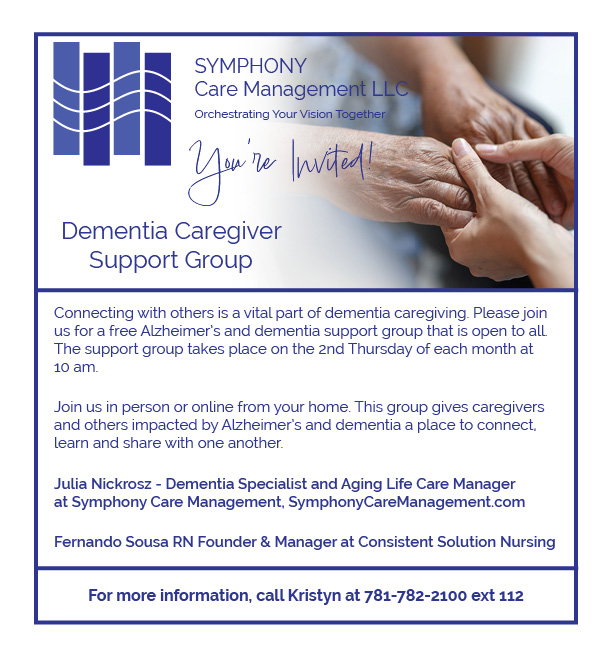
Join Symphony Care Management Dementia Caregiver Support Group: In-Person or Online
Dementia Caregiver Support Group meets on the 2nd Thursday of every month at 10am, in person or virtual participation. Join us!